When a gamma-ray burst lights up the sky for over a minute and then, days later, its afterglow starts brightening again, astronomers pay attention. GRB 260610B did exactly that. Starithm tracked it in real time, from the first Fermi trigger through nearly three weeks of follow-up.
Alert Timeline
Fermi's Gamma-ray Burst Monitor (GBM) triggered at 2026-06-10 23:46:14 UTC. Seven notices followed, all stamped 23:46 UTC. The first was the trigger alert itself. The first GBM onboard position placed the burst at RA=227.48° Dec=25.95°, with GBM classifying the trigger as GRB (67%). Ground analysis then shifted it to RA=223.23° Dec=23.20°. A second onboard position gave RA=221.42° Dec=22.12° (GRB, 69%), and a second ground-analysis position gave RA=224.00° Dec=23.71°. Two final-position notices then converged on the event's best localisation: RA 218.6600°, Dec +23.9400° ± 2.77° (FERMI_GBM_FIN_POS).
!Fermi GBM sky map showing the localisation region of GRB 260610B

The Fermi GBM Burst Catalog records a T90 of 62.21 ± 1.379 s, a fluence of 1.16e-5 ± 6.14e-8 erg/cm2, and a peak flux of 7.731 ± 0.2962 ph/cm2/s.
!Fermi GBM light curve of GRB 260610B

What the Community Found
GOTO found the optical counterpart, GOTO26fua/AT2026owq, at 16.66 AB mag, fading to 17.83 AB mag (GCN 44903). ATLAS had imaged the field just 7.9 minutes after the burst and recorded a first detection at 16.26 AB mag (GCN 44910). COLIBRÍ's five-filter photometry showed no strong break, suggesting a low redshift (GCN 44911). NOT/ALFOSC spectroscopy soon measured z=0.473 (GCN 44914). VLT/FORS2 later confirmed z = 0.474 (GCN 45004).
SVOM/GRM reported an observer-frame Epeak of 25 keV and a T90 of 65.0 ± 8.0 seconds. The team classified the burst as a Type II GRB consistent with the 'Amati' relation (GCN 44944).
!SVOM/GRM Amati relation plot for GRB 260610B
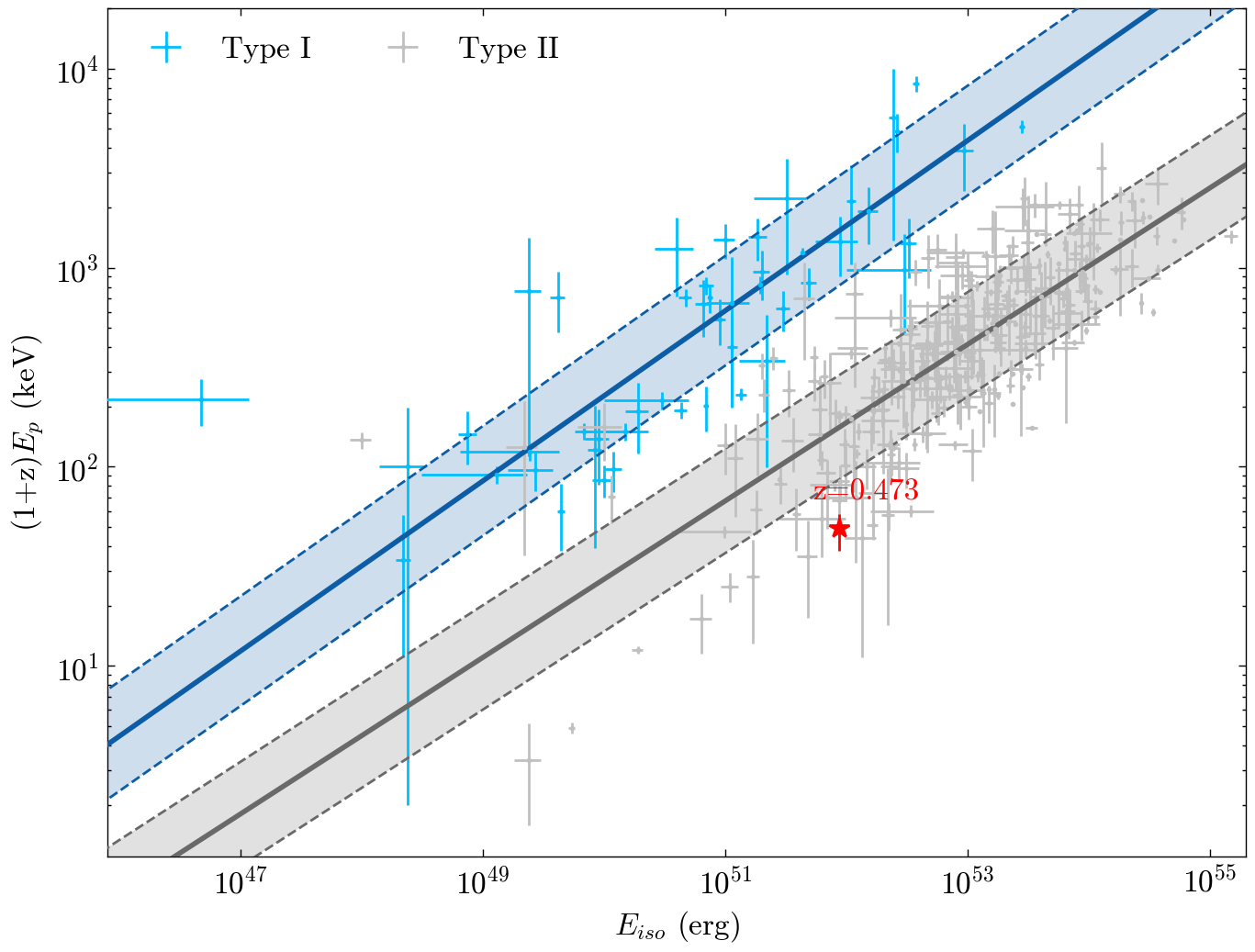
Then the light curve misbehaved. Pan-STARRS reported re-brightening or flattening in griz (GCN 44955). COLIBRÍ confirmed it at about 80 hours, with r = 21.02 (GCN 44958). The Liverpool Telescope called the episode achromatic beyond 5 days, inconsistent with an emerging supernova (GCN 44959). VLT/FORS2 spectroscopy attributed the rebrightening to late jet activity of non-thermal nature, while hinting at a possible supernova (GCN 45004).
ALMA detected the burst at about 0.3 mJy (GCN 44941), and the VLA found a radio counterpart at about 0.4 mJy at 9 GHz (GCN 45065).
Starithm's Read
GRB 260610B is a long, soft burst at modest redshift with a very well-sampled afterglow. Its 62-second duration and its placement on the Amati relation point toward a collapsar origin (GCN 44944). The real story is the late-time behaviour. Several teams independently saw a rebrightening across filters that did not change colour, and the spectroscopy favours renewed jet activity over supernova light. Still, GCN 45062 suggested the brightening might indicate a supernova, and FORS2 left room for one. Both processes may be contributing.
Why This Matters
Late rebrightenings test our models of how GRB central engines shut down. They may reflect energy injection, structured jets, or the engine itself switching back on. Telling these apart from supernova light requires exactly this kind of dense, multi-band, multi-wavelength coverage, gathered by dozens of telescopes worldwide. At z ≈ 0.47, this event is close enough that spectroscopy can still separate the two scenarios.
Follow the next burst as it unfolds, notice by notice, on Starithm.
---
Live Event Page
Track this event in real time on Starithm: 802827979 — Live Event Page
---
Cite This Post
If you reference this event report in your research, please cite:
```bibtex @misc{starithm2026802827979, title = {Long GRB 260610B detected by Fermi GBM with optical counterpart and multi-wavelength follow-up}, author = {{Starithm Platform}}, year = {2026}, url = {https://starithm.ai/blog/posts/event-802827979}, note = {Real-time astronomical event monitoring report, Starithm} } ```