A Gamma-Ray Burst Unfolds in Real Time: GRB 260718A
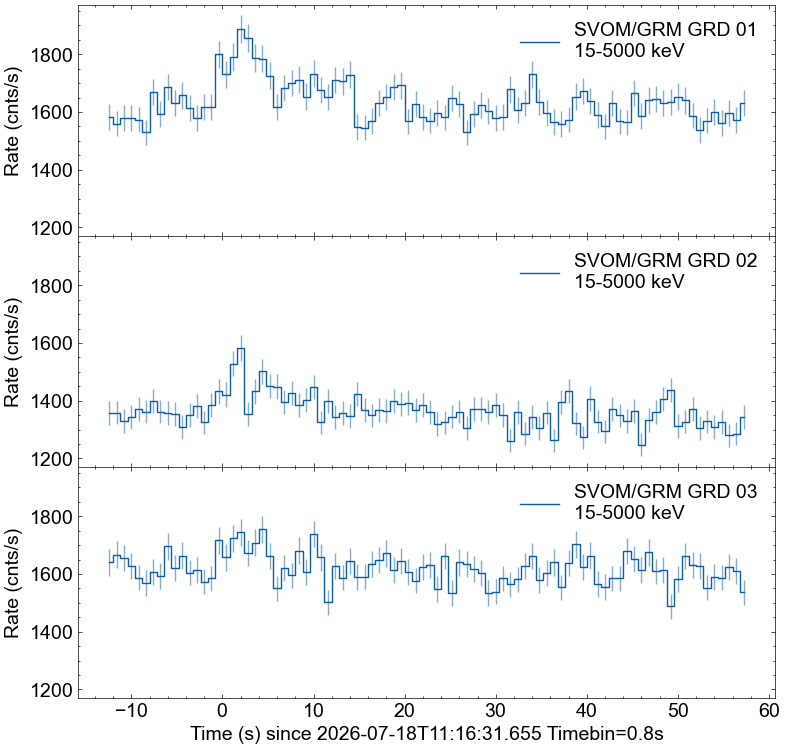
On July 18, 2026, the cosmos delivered a spectacular reminder of why astronomers keep their eyes on the sky around the clock. Starithm's real-time monitoring system tracked GRB 260718A from its first detection through a coordinated global follow-up campaign that revealed an intriguing X-ray counterpart. This event—a 19-second gamma-ray burst with a peak photon flux of 2.1 ph/s/cm²—demonstrates how modern alert networks and rapid response can turn a transient cosmic flash into a multi-wavelength investigation.
Alert Timeline: Minutes That Matter
The burst arrived at 11:16:34 UTC on July 18, triggering a cascade of detections across space-based observatories. The Fermi Gamma-ray Burst Monitor (GBM) issued its initial alert within seconds, though the first automated notice placed the source at RA = 0.00°, Dec = 0.00°—the null position indicating raw trigger data with no localisation yet. Within moments, refined positions began arriving. The flight localisation narrowed the burst to RA = 42.12°, Dec = −50.87°, while ground-based analysis from Fermi produced RA = 41.88°, Dec = −38.61°. The final Fermi position settled at RA = 26.61°, Dec = −43.95°, illustrating the iterative refinement process that guides follow-up observations.
Crucially, SVOM/ECLAIRs detected the same burst independently, localising it to a 90% confidence radius of just 4.20 arcmin with an impressive signal-to-noise ratio of 20.86 in the 5–20 keV band. This multi-instrument confirmation elevated confidence in the source location and triggered a coordinated response.
!GRB 260718A field and localisation region from SVOM observations
What the Community Found
The ground-based response was swift but ultimately empty-handed in the optical domain. The SVOM/VT telescope began observations 44 minutes post-burst, searching for an optical counterpart but finding none deeper than AB > 23.2 mag. This non-detection was corroborated by independent teams: the GRANDMA and KNC networks reported consistent null results, and the LCO 1m telescope at Siding Spring Observatory (observing ~7.3 hours later) also saw nothing brighter than AB ≈ 20.1 mag within the error circle.
The breakthrough came from X-rays. The Einstein Probe (EP), performing follow-up observations just 53 minutes after the trigger, identified an uncatalogued X-ray source sitting squarely within the GRB error circle. This detection fundamentally changed the event's character: no optical counterpart, but a persistent X-ray source suggests either significant dust obscuration along the line of sight or an intrinsically faint optical transient paired with a bright X-ray afterglow.
Starithm's Read
Our analysis synthesises these observations into a coherent picture: GRB 260718A represents a classic case of a high-significance gamma-ray burst detected by multiple space instruments, followed by rapid X-ray localisation but optical obscurity. The 19-second duration and spectral hardness are consistent with a long GRB, potentially originating from massive star collapse. The X-ray counterpart's presence without optical detection hints at an environment rich in dust or an unusually steep optical-to-X-ray spectral slope.
Why This Matters
Events like GRB 260718A are laboratories for understanding extreme physics. Each detection refines our models of how massive stars die and how relativistic jets propagate through their environments. Real-time monitoring platforms like Starithm enable the coordinated global response that transforms fleeting signals into lasting science.
Follow the next cosmic drama as it unfolds—track real-time events on Starithm.
---
Live Event Page
Track this event in real time on Starithm: 806066200 — Live Event Page
Update — 2026-09-02
The SVOM/ECLAIRs team has completed a refined spectral analysis of GRB 260718A, revealing important characteristics of this July 2026 event. The burst displays a notably simple morphology with a single peak lightcurve and a duration of 17.4 seconds, placing it within the long gamma-ray burst classification. Spectral fitting using a power-law model has yielded precise measurements of the burst's fluence and photon flux, providing quantitative constraints on the event's energetics.
This refined analysis suggests a relatively uncomplicated emission mechanism, contrasting with the complex multi-peaked profiles often observed in other long GRBs. The power-law spectral character is consistent with synchrotron radiation from relativistic shocks, a standard interpretation for GRB prompt emission. These new measurements enhance our understanding of GRB 260718A's physical properties and contribute to the growing dataset of well-characterized bursts from SVOM/ECLAIRs observations.
---
Live Event Page
Track this event in real time on Starithm: 806066200 — Live Event Page
---
Cite This Post
If you reference this event report in your research, please cite:
```bibtex @misc{starithm2026806066200, title = {Gamma-ray burst GRB 260718A detected by Fermi GBM and SVOM, showing a single peak lightcurve.}, author = {{Starithm Platform}}, year = {2026}, url = {https://starithm.ai/blog/posts/event-806066200}, note = {Real-time astronomical event monitoring report, Starithm} } ```