A Bright Gamma-Ray Burst Lights Up the Sky: Inside GRB 260727A
On the morning of July 27, 2026, the SVOM mission's gamma-ray detectors caught something remarkable: a brilliant, long-duration gamma-ray burst that would soon capture the attention of observatories across the globe. Starithm tracked GRB 260727A in real time, receiving alerts within seconds of detection and monitoring the cascade of follow-up observations that unfolded over the next 24 hours. This event exemplifies why real-time monitoring matters—it's the difference between catching a transient at its brightest and arriving too late to see anything at all.
Alert Timeline
The first indication came at 2026-07-27 00:21 UTC when SVOM's Gamma-Ray Monitor (GRM) registered the event at RA = 37.88°, Dec = 59.21°. Within seconds, the mission's ECLAIRs instrument—the spacecraft's primary X-ray burst monitor—confirmed the detection and began refining the position. A second notice arrived at 00:21 UTC with an updated localization at RA = 331.44°, Dec = 74.55°, and a third refinement followed just one minute later. By 00:22 UTC, SVOM had locked onto the burst's position with a 90% confidence radius of 2.12 arcmin, pinpointing coordinates of RA 22h06m34.69s, Dec 74d32m25.98s.
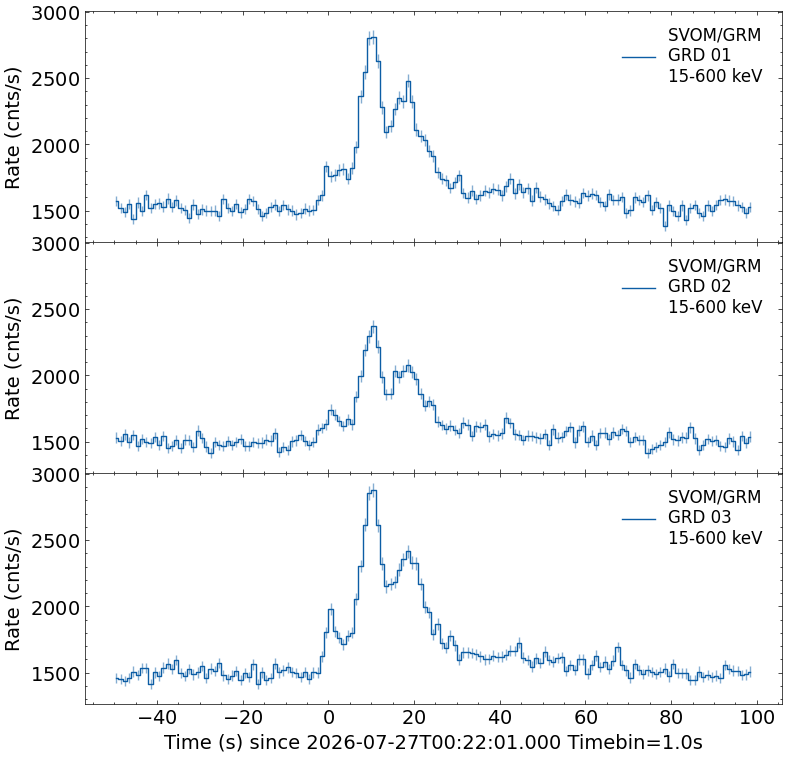
The timing was crucial. Within two minutes, automated brokers had alerted observatories worldwide. What Starithm's real-time feed revealed was a complex, multi-peaked light curve unfolding over 66.5 seconds—far longer than the brief, violent flares that characterize short bursts. The spectrum showed a clear power-law distribution with an exponential cutoff, a signature feature of long-duration GRBs.
!SVOM light curve of GRB 260727A showing multiple emission peaks across 66.5 seconds
What the Community Found
The follow-up campaign was swift and comprehensive. AstroSat's CZTI instrument independently confirmed the burst, measuring a T90 duration of approximately 20 seconds in the 20–200 keV and 100–500 keV bands—suggesting some variation in how the burst appeared at different energies. The Glowbug detector aboard the International Space Station also caught the event, recording a significance of 24.2 sigma with a measured duration of 22.5 seconds.
But despite the burst's brightness in gamma rays, optical telescopes drew a blank. The LCO 1m at Tenerife Observatory, Palomar's WINTER camera, GOTO, RAPAS, and the Liverpool Telescope all reported non-detections within the error circle. The deepest optical limit came from Liverpool at r > 22.17 mag approximately 25 hours post-burst—suggesting either a very distant source or significant dust obscuration.
Most intriguingly, SVOM's follow-up X-ray observations revealed an uncatalogued X-ray source within the ECLAIRs error circle, detected after 6.1 ks of exposure. This source remains unidentified and warrants deeper investigation.
Starithm's Read
Our AI synthesis flagged GRB 260727A as high-significance: a textbook long-duration burst with multiple peaks, consistent with a massive star core collapse. The complex temporal structure and spectral properties fit established collapsar models, though the optical darkness and mysterious X-ray source hint at complications.
Why This Matters
Long GRBs probe the deaths of massive stars across cosmic distances. Each well-observed event refines our understanding of stellar evolution, relativistic jet physics, and the diversity of transient phenomena. The uncatalogued X-ray source particularly demands follow-up—it could represent an unusual afterglow component or an entirely separate phenomenon.
Track the next bright transient as it unfolds on Starithm.
---
Live Event Page
Track this event in real time on Starithm: sb26072701 — Live Event Page
---
Cite This Post
If you reference this event report in your research, please cite:
```bibtex @misc{starithm2026sb26072701, title = {Bright long-duration GRB 260727A detected by SVOM with multiple peaks.}, author = {{Starithm Platform}}, year = {2026}, url = {https://starithm.ai/blog/posts/event-sb26072701}, note = {Real-time astronomical event monitoring report, Starithm} } ```