A Bright Messenger from the High North: GRB 260727A
On the morning of July 27, 2026, the cosmos delivered an unmistakable knock on our door. The SVOM mission's ECLAIRs instrument caught a brilliant gamma-ray burst that would occupy the attention of observatories across the globe for the next 24 hours. Starithm's real-time monitoring system flagged the event immediately, tracking the alert cascade and community response as it unfolded. This was GRB 260727A—a bright, long-duration burst with an intriguing multi-peaked structure that challenged simple interpretations and sparked a coordinated hunt for its optical and infrared fingerprints.
Alert Timeline
The burst arrived at 2026-07-27 00:22:02 UTC, detected by SVOM/ECLAIRs and rapidly localized to RA = 331.63°, Dec = 74.55° with a 90% confidence radius of 2.12 arcmin. Within minutes, Starithm's alert aggregator captured the initial notices propagating through the Gamma-ray Coordinates Network. The SVOM team's rapid notification proved critical: within hours, multiple independent instruments confirmed the detection. The Glowbug gamma-ray telescope aboard the International Space Station independently observed the burst, measuring a duration of 22.5 seconds and achieving a significance of 24.2 sigma—a gold-standard detection. Meanwhile, India's AstroSat CZTI instrument registered the same event across multiple energy bands, documenting T90 ≈ 20 seconds with pronounced multiple emission peaks in both the 20–200 keV and 100–500 keV ranges.
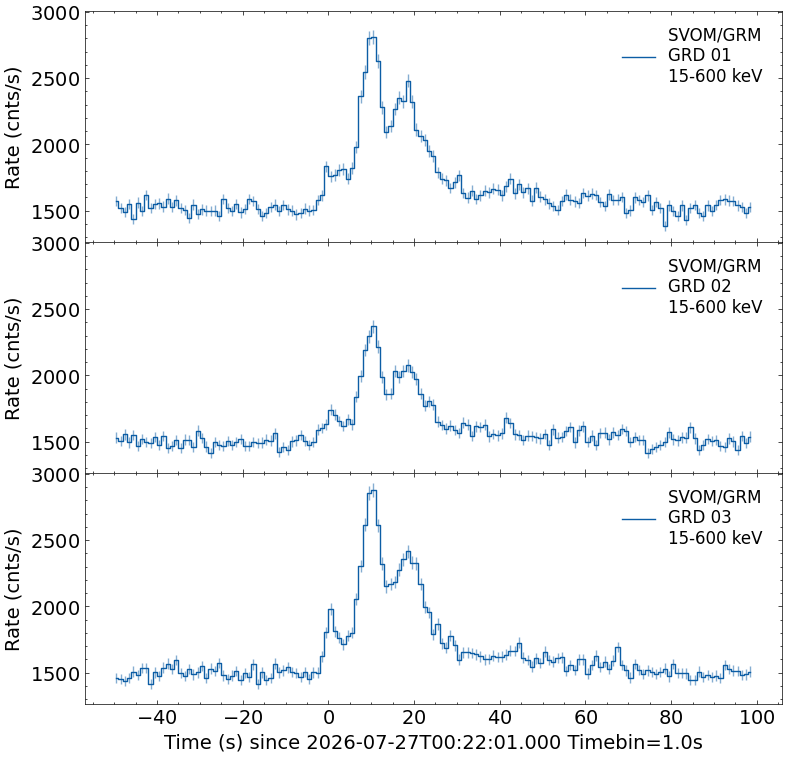
The multi-peaked morphology was immediately striking. Rather than a smooth rise-and-decay profile, this burst showed distinct structural features—suggesting complex energy release processes, possibly from a precessing jet or multiple accretion episodes.
What the Community Found
The global response was swift and comprehensive. Within 2.16 hours, the LCO 1-meter telescope at Tenerife Observatory scanned the error box but found nothing—optical magnitude limit z > 20.2 AB. The GOTO collaboration, GRANDMA/Kilonova-Catcher network, and RAPAS robotic telescope array all reported null detections in optical bands. Palomar's WINTER camera set a near-infrared upper limit of J = 19.19 mag. Even the Liverpool Telescope's deep observations at 24.75 hours post-trigger yielded no counterpart, with limits reaching r > 22.17 and i > 22.05 mag.
Yet there was one discovery amid the non-detections: SVOM's follow-up X-ray observations revealed an uncatalogued X-ray source within the ECLAIRs error circle, detected after 6.1 ks of exposure. This source's spectrum and flux were analyzed, though its connection to the burst itself remained ambiguous.
!GRB 260727A spectral properties and hardness ratios
Starithm's Read
The data portrait emerging from this coordinated campaign tells a nuanced story. A bright, multi-peaked long-duration burst with no obvious optical or near-infrared afterglow, paired with an enigmatic X-ray source, points toward either significant dust obscuration along the line of sight or an intrinsically dark transient. The burst's structure and energetics warrant comparison against established correlations in the GRB population.
Why This Matters
GRB 260727A exemplifies modern multi-messenger astronomy: a single transient triggering observations across the electromagnetic spectrum within minutes. The null optical detections constrain models of jet composition and circumburst environments, while the X-ray source discovery hints at unexpected complexity.
Follow real-time events like this on Starithm—where the universe's most violent moments are tracked as they happen.
---
Live Event Page
Track this event in real time on Starithm: sb26072702 — Live Event Page
Update — 2026-09-21
Update
Refined analysis from the SVOM/ECLAIRs team has confirmed GRB 260727A as a long gamma-ray burst with a complex temporal structure characterized by multiple peaks and a T90 duration of 66.5 seconds. The event's detection across an unprecedented network of instruments—including SVOM/GRM, AstroSat/CZTI, Glowbug, and Konus-Wind—provides robust multi-wavelength constraints on the burst properties and strengthens confidence in the source localization.
A critical development comes from EP-FXT's second follow-up observation, which has identified a faint X-ray source associated with the burst location. The detected source exhibits specific spectral characteristics consistent with an afterglow, marking the first direct evidence of X-ray emission following the initial gamma-ray event. This detection bridges the immediate burst phase and longer-term afterglow evolution, providing essential data for constraining the burst's energetics and progenitor environment.
---
Live Event Page
Track this event in real time on Starithm: sb26072702 — Live Event Page
---
Cite This Post
If you reference this event report in your research, please cite:
```bibtex @misc{starithm2026sb26072702, title = {Bright GRB 260727A detected by SVOM with multiple peaks and X-ray afterglow.}, author = {{Starithm Platform}}, year = {2026}, url = {https://starithm.ai/blog/posts/event-sb26072702}, note = {Real-time astronomical event monitoring report, Starithm} } ```