GRB 260909A: When a Gamma-Ray Burst Goes Dark
On September 9, 2026, the cosmos delivered a puzzle. The SVOM mission caught a bright, energetic gamma-ray burst—but when ground-based observers rushed to find its optical glow, they found almost nothing. Starithm tracked this event live as it unfolded across multiple wavelengths and observatories, capturing a rare "dark GRB" that challenges our understanding of how these cosmic explosions shine.
Alert Timeline
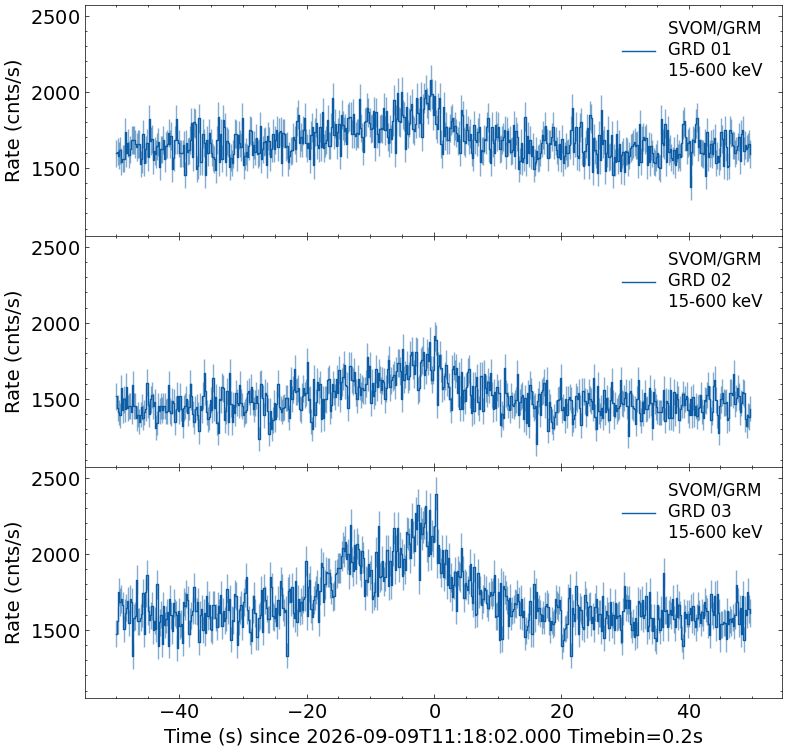
The first alert arrived at 11:17 UTC when SVOM's ECLAIRs instrument triggered on a burst at RA = 13.0009°, Dec = 24.2188° with an uncertainty of 6.67 arcmin. The gamma-ray signal was unmistakable: a 47-second duration burst in the 4–120 keV band with fluence = 9.4 × 10⁻⁶ erg/cm² and a photon index of −1.23, indicating a relatively hard spectrum typical of long-duration GRBs.
Four minutes later, at 11:21 UTC, a second alert confirmed the localization. SVOM's Microchannel X-ray Telescope (MXT) had independently pinpointed an uncatalogued X-ray source, narrowing the error box and signalling that this was a genuine, multi-instrument detection. The multi-peak structure of the gamma-ray light curve—evident in data from both ECLAIRs and the Gamma-Ray Monitor (GRM)—suggested a complex, turbulent progenitor system.
!GRB 260909A spectral properties and light curve from SVOM instruments
What the Community Found
The optical response was swift but frustrating. Within 21 minutes, SVOM's own optical telescope (C-GFT) reported a non-detection: i > 20.1 AB. The Xinglong 2.16m telescope followed with R > 20.6 mag, and the VLT delivered even deeper limits across infrared bands. Yet one tantalizing report from the Sayan Solar Observatory suggested a faint R = 21.6 mag source—a candidate that sparked debate but remained unconfirmed by subsequent observations.
The X-ray picture was clearer. The Einstein Probe detected a fading X-ray afterglow, EPF_J005208.3+241147, with a 0.5–10 keV flux of 4.07 × 10⁻¹² erg/cm²/s, confirming that the burst had indeed produced energetic high-energy emission. Radio observers also chimed in: the Australia Telescope Compact Array (ATCA) detected a radio counterpart, adding another piece to the puzzle.
Starithm's Read
The data paint a coherent picture: a long-duration GRB with robust high-energy and radio signatures, but a suppressed or absent optical afterglow. This "darkness" could reflect heavy dust obscuration along the line of sight, a high redshift, or an intrinsically dim optical component—perhaps because the burst's energy was channeled preferentially into high-frequency photons and relativistic jets. The multi-peak gamma-ray structure and spectral hardness are consistent with a collapsar origin, but the optical darkness suggests either an unusual progenitor environment or viewing geometry.
Why This Matters
Dark GRBs challenge simple afterglow models and hint at the diversity of explosion mechanisms and environments. Each one is a natural experiment in extreme physics—and a reminder that the universe's most violent events don't always announce themselves in visible light.
Follow real-time cosmic events like GRB 260909A as they happen on Starithm.
---
Live Event Page
Track this event in real time on Starithm: sb26090910 — Live Event Page
---
Cite This Post
If you reference this event report in your research, please cite:
```bibtex @misc{starithm2026sb26090910, title = {SVOM detects long-duration GRB 260909A with multi-wavelength follow-up}, author = {{Starithm Platform}}, year = {2026}, url = {https://starithm.ai/blog/posts/event-sb26090910}, note = {Real-time astronomical event monitoring report, Starithm} } ```