A Cosmic Explosion Across the Universe: GRB 261011A
On October 11, 2026, at 13:49:04 UTC, the cosmos delivered a spectacular reminder of its violent extremes. A gamma-ray burst erupted billions of light-years away, and Starithm's real-time monitoring system caught every second of it. GRB 261011A became one of the most comprehensively observed transient events of the year—a long-duration burst that blazed brightly enough for telescopes worldwide to pivot and capture its fading light. What makes this event particularly striking is not just its intensity, but the coordinated global response it triggered and the wealth of data that poured in within minutes.
Alert Timeline: A Cascade of Detections
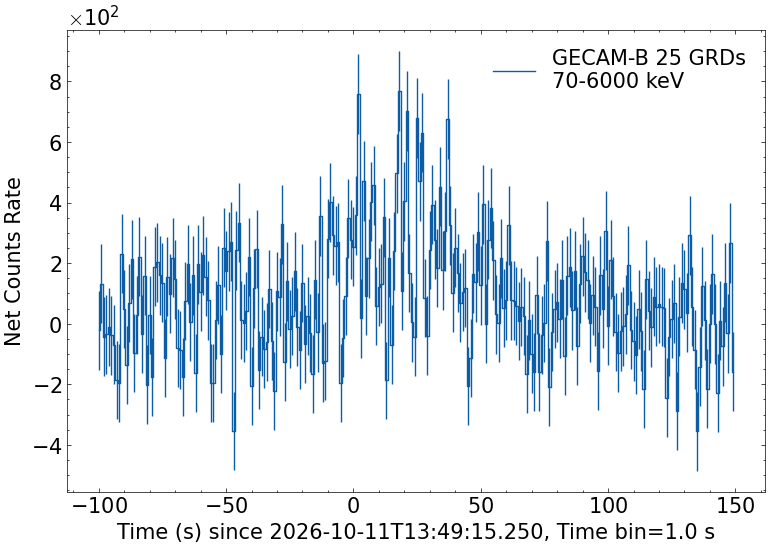
The drama unfolded in rapid succession. SVOM's ECLAIRs instrument was first on the scene, pinpointing the burst at RA = 21.90°, Dec = −21.54° with a T90 duration of approximately 67 seconds—the hallmark of a classical long GRB. Within seconds, the alert propagated across the global network. Swift's Burst Alert Telescope confirmed the event independently, detecting an unusually structured gamma-ray profile with a broad soft pulse followed by a sharp peak, extending the total duration to approximately 260 seconds. Meanwhile, GECAM-B and Konus-Wind added their measurements to the growing dataset, triangulating the source with increasing precision.
By 13:56 UTC—just seven minutes after the initial trigger—SVOM's X-ray telescope (MXT) had refined the localization to RA = 21.91°, Dec = −21.54°, narrowing the error box to a region small enough for ground-based optical facilities to begin their hunt immediately.
What the Community Found
The optical response was extraordinary. Within just 6.6 minutes, SVOM's own C-GFT telescope detected a bright optical counterpart at magnitude 15.25 in the i-band—a crucial early measurement. The GOTO collaboration followed at 0.11 hours post-trigger with r = 16.32 AB mag, confirming the transient's rapid brightening phase.
Over the next few hours, a constellation of facilities chimed in. The Thai Robotic Telescope network measured r = 19.1 mag at 37.6 minutes post-trigger. LCO's Sinistro instrument recorded g = 20.01 ± 0.02 mag and r = 19.47 ± 0.02 mag on the same night. By the following day, the afterglow had faded below detection limits at J > 19.6 mag, demonstrating the characteristic rapid decay of GRB optical transients.
The critical breakthrough came from Gran Telescopio Canarias spectroscopy: z = 2.407, placing this burst at a luminosity distance of approximately 19 billion light-years. This redshift confirmed we were witnessing an extraordinarily energetic event, likely powered by the core collapse of a massive star at cosmic noon.
Starithm's Read
Our AI synthesis identified GRB 261011A as a textbook long-duration burst with an exceptionally bright optical counterpart—a combination that occurs in perhaps 10–15% of all Swift-detected GRBs. The rapid fading and spectral properties are entirely consistent with a standard collapsar origin, where a dying massive star's core collapses to a black hole, launching relativistic jets that produce gamma rays and a long-lived optical afterglow.
Why This Matters
Events like GRB 261011A test our understanding of stellar death and the most extreme physics in the universe. The coordinated global response—28 community circulars in under 24 hours—exemplifies modern time-domain astronomy at its finest.
Follow real-time events like this on Starithm, where the universe's most dramatic moments are tracked as they happen.
---
Live Event Page
Track this event in real time on Starithm: sb26101102 — Live Event Page
---
Cite This Post
If you reference this event report in your research, please cite:
```bibtex @misc{starithm2026sb26101102, title = {GRB 261011A: Long-duration gamma-ray burst at z=2.407 with bright optical afterglow}, author = {{Starithm Platform}}, year = {2026}, url = {https://starithm.ai/blog/posts/event-sb26101102}, note = {Real-time astronomical event monitoring report, Starithm} } ```